Green Roofs in a warm subhumid climate: Experimental monitoring
Keywords:
Green roofs, Energy efficiency, Warm sub-humid climate, Thermal insulation, R-Value, Thermal resistance, Artificial cooling, Sustainable housing, Building envelope, NMX-C-460-ONNCCE-2009 Standard, Electricity consumption, Urban heat islands, Local materials, Bioclimatic architecture, Sustainable architectureSynopsis
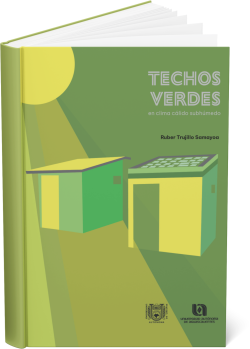
This book presents an experimental investigation on the thermal and energy performance of green roofs in houses located in hot sub-humid climates, taking as a case study the city of Tuxtla Gutierrez. Through measurements made in two full-scale test cells -one with a green roof and the other with a reinforced concrete roof- the author evaluates surface temperatures, electrical consumption and thermal resistance according to Mexican standard NMX-C-460-ONNCCE-2009. The study demonstrates that extensive green roofs, built with local materials and endemic vegetation, can significantly reduce heat transfer to the interior of dwellings and improve energy efficiency.
The results show that the green roof allows a 20% saving in air conditioning consumption and meets the minimum thermal resistance values established by regulations, unlike conventional roofs. In addition, the book contextualizes the energy and climate problems of Tuxtla Gutiérrez, marked by high temperatures, accelerated urban growth and the widespread use of concrete roofs. The book concludes that green roofs represent a viable, economical and replicable alternative to mitigate urban heat islands, reduce energy consumption and promote more sustainable and affordable housing in tropical regions.
References
Aboelata , A. (2021). Evaluación de los beneficios de los techos verdes en el ahorro energético de los edificios mediante la refrigeración de espacios exteriores en diferentes densidades urbanas en ciudades áridas. Science, 129. https://doi.org/10.1016/j.energy.2020.119514
Aboelata, A. (2021). Evaluación de los beneficios de los techos verdes en el ahorro energético de los edificios mediante la refrigeración de espacios exteriores en diferentes densidades urbanas en ciudades áridas. Science, 129. doi: https://doi.org/10.1016/j.energy.2020.119514
Álvarez Marqués, J. L., Hernández perla, P. F., & Prieto Hernández, C. L. (2023). Beneficio productivo, económico-social. Revista de Arquitectura e Ingeniería, 17(1). https://www.redalyc.org/journal/1939/193974540001/193974540001.pdf
Álvarez Marqués, J. L., Hernández perla, P. F., & Prieto Hernández, C. L. (2023). Beneficio productivo, económico-social. Revista de Arquitectura e Ingeniería, 17(1). Retrieved from https://www.redalyc.org/journal/1939/193974540001/193974540001.pdf
Andreoni Trentacoste, S. (2024). Caracterización de hábitos de uso y gestión de viviendas en una ciudad de clima árido. construcción de perfiles de comportamiento: en cuanto al desempeño termoenergético. Cuaderno Urbano. Espacio,cultura, sociedad, 39(39 91 114), 91 - 114. https://doi.org/10.30972/crn.39397895
Andreoni Trentacoste, S. (2024). CARACTERIZACIÓN DE HÁBITOS DE USO Y GESTIÓN DE VIVIENDAS EN UNA CIUDAD DE CLIMA ÁRIDO. CONSTRUCCIÓN DE PERFILES DE COMPORTAMIENTO: EN CUANTO AL DESEMPEÑO TERMOENERGÉTICO. CUADERNO URBANO. Espacio,cultura, sociedad, 39(39 91 114), 91 - 114. doi: https://doi.org/10.30972/crn.39397895
Auliciems, A., & Szokolay, S. V. (1999). Thermal Comfort. PLEA: Passive and Low Energy Architecture, Department of Architecture. University of Queensland.
Auliciems, A., y Szokolay, S. V. (1999). Thermal Comfort. PLEA: Passive and Low Energy Architecture, Department of Architecture. University of Queensland.
Cabrera, S., Guilarducci, A., González, D., & Suarez, M. (2023). EVALUACIÓN DEL COEFICIENTE. Revista Hábitat Sustentable, 13(1), 08-19. https://doi.org/10.22320/07190700.2023.13.01.01
Cabrera, S., Guilarducci, A., González, D., & Suarez, M. (2023). EVALUACIÓN DEL COEFICIENTE. Revista Hábitat Sustentable, 13(1), 08-19. https://doi.org/10.22320/07190700.2023.13.01.01
Calderón, J., Lara, A., & Campoverde, J. A. (2025). Hacia un Futuro Sostenible: Políticas y Perspectivas de Energías Alternativas. SCT Proceedings in Interdisciplinary Insights and Innovations, 3. https://doi.org/10.56294/piii2025415
Calixto Aguirre, V. I., & Huelsz Lesbros, G. (11 de 05 de 2018). Consumo de energía en edificios en México. Revista Legado de Arquitectura y Diseño(núm. 24,), 40-47. Recuperado el 22 de 01 de 2026, de https://www.redalyc.org/journal/4779/477957975006/html/
Carrier. (17 de Diciembre de 2024). Manual de Instalación, Usuario y Control Remoto. Ciudad de México, Ciudad de México, México. Obtenido de https://www.carrier.com.mx/: https://www.carrier.com.mx/
Castañeda Nolasco , G., Ferras Coutiño, H., Farrera Vázquez, N., & Jiménez Albores, J. L. (2024). Tecnología para techo de vivienda de producción social. Academia XXII, 15(30), 317-333. doi: https://doi.org/10.22201/fa.2007252Xp.2024.15.30.90234
Castañeda, G., & Vecchia, F. (2007). Sistema de techo alternativo para vivienda progresiva en Tuxtla Gutiérrez, Chiapas, Mexico. Ingeniería, Revista Académica de la FI-UADY, 21-30.
Castillo Quimis, E. L., Mite Pezo, J. A., & Pérez Arévalo, J. J. (2019, Julio). INFLUENCIA DE LOS MATERIALES DE LA ENVOLVENTE EN EL CONFORT TÉRMICO DE LAS VIVIENDAS. Revista Universidad y Sociedad, 11(4). doi: http://scielo.sld.cu/pdf/rus/v11n4/2218-3620-rus-11-04-303.pdf
Castleton, H. F., Stovin, V., Beck, S. B., & Davidson, J. B. (2010). Green roofs; building energy savings and the potential for retrofit. Energy and Buildings, Volume 42, Issue 10, 1582-1591. https://doi.org/10.1016/j.enbuild.2010.05.004
cna. (2024). Sistema Meteorológico Nacional; Comisión Nacional del Agua. Obtenido de http://smn.cna.gob.mx/observatorios/ManualObservador.pdf
conuee. (03 de 07 de 2024). Gobierno de México. Obtenido de Consejos sobre ahorro de energía en tu casa: https://www.gob.mx/conuee/acciones-y-programas/consejos-sobre-ahorro-de-energia-en-tu-casa
Dauda, I., & Zafer Alibaba, H. (2020). Green Roof Benefits Opportunities And Challenges. International Journal of Civil and Structural Engineering Research, 7, 106–112. Obtenido de https://tinyurl.com/24j898j5
García, E. (1998). Climas (Clasificación de Köppen, modificado por García)” Escala 1:1000,000. México: CONABIO.
García, V. I. (2010). Beneficios de los Sistemas de Naturación. Semana Nacional de Energía Solar, 2010, (SNES2010-ABC-022), 221-232. Retrieved from https://tinyurl.com/238ew3ey
Gay, C., Estrada, F., & Martínez, B. (2010). Cambio climático y estadística oficial. Realidad datos y espacio, 7.
Gomez Azpetia, G., Borjoquez Morales , G., & Ruiz Torres, R. P. (2007). Confort termico: Dos enfoques teoricos enfrentados. Palapa, 2(1), 45-57.
González Calderón,, A. J., Quiroa Herrera, J. A., Villanueva Solís, J., & Llaven José, H. (2024). Habitabilidad térmica en espacios educativos para infantes. Arquitectura +, 9(17). doi: https://doi.org/10.5377/arquitectura.v9i17.18220
Guillén Guillén, C. A., & Muciño Vélez, A. (21 de 03 de 2020). Ahorro energético en vivienda social mediante la implementación de materiales regionales. Vivienda y Comunidades Sustentables(8), 59-80,. doi: https://doi.org/10.32870/rvcs.v0i8.142
H. Ayuntamiento de Tuxtla Gutiérrez. (2024). Tuxtla 2030, La Agenda estratégica de nuestra ciudad. Tuxtla Gutierrez, Chiapas: H. Ayuntamiento Municipal de Tuxtla Gutiérrez, Chiapas. Obtenido de http://www.tuxtla.gob.mx/iciplam/descargas/Tuxtla2030.pdf
https://www.wunderground.com/. (11 de Noviembre de 2024). https://www.wunderground.com/. Obtenido de https://www.wunderground.com/: https://www.wunderground.com/
igra. (2015 йил 14-Septiembre). International Green Roof Association. Retrieved from http://www.igra-world.com/
INEECC. (04 de Septiembre de 2025). Instituto Nacional de Ecología y Cambio Climatico. Obtenido de http://www2.inecc.gob.mx/publicaciones/libros/685/inventario.pdf
inegi. (2018). PRIMERA ENCUESTA NACIONAL SOBRE CONSUMO DE ENERGÉTICOS. inegi. Obtenido de https://tinyurl.com/yj3523gz
inegi. (2020). Censo de Población y Vivienda, 2010. inegi.
inegi. (2023). Aspectos Georaficos de Chiapas. inegi. Obtenido de https://tinyurl.com/22ft7rfc
Instituto Ciudadano de Planeacion. (25 de Enero de 2024). Obtenido de http://decalogopublicidad.com/Tuxtla2030.pdf
Instituto de Desarrollo Sostenible. (2024). Gases y efecto invernadero. Obtenido de Local2030: http://2gasesoramiento.blogspot.com/2016/02/caso-real-cuantos-arboles-necesito.html
Jia, S., Weng, Q., Yoo, C., Xiao, H., & Zhong, Q. (2024). Building energy savings by green roofs and cool roofs in current and future climates. npj Urban Sustainability, 4(23). doi:https://doi.org/10.1038/s42949-024-00159-8
López González, B. G., Camacho, A. D., Martínez Rodríguez, M. C., & Marcelino Aranda, M. (2020). Techos verdes: una estrategia sustentable. Tecnología en Marcha,, 33(3), 68-79. doi: https://doi.org/10.18845/tm.v33i3.4389
McQuiston, F. C., Parker, J. D., & Spitler, J. D. (2010). Heating, Ventilating and Air Conditioning, Analisis and Design. New York: John Wiley & Sons, LTD.
Mohsen, S., Hosseinzadeh, M., Bruce, D., Farzaneh, B., Hamid, S., & Nasrin, A. (2022). Sustainable green roofs: a comprehensive review of influential factors. Environmental Science and Pollution Research. doi: https://doi.org/10.1007/s11356-022-23405-x
nasa. (2024). Temperatura global. Obtenido de Ciencia nasa: https://ciencia.nasa.gov/cambio-climatico/temperatura-global/
ONNCCE. (2009). Industria de la Construcción Aislamiento térmico valor “R” para las envolventes de vivienda por zona térmica para la República Mexicana especificaciones y verificación. México D. F.: ONNCCE.
Onset. (28 de Noviembre de 2023). https://www.onsetcomp.com/products/. Obtenido de https://www.onsetcomp.com: https://www.onsetcomp.com/products/software/hoboware
Onset. (28 de Noviembre de 2023). https://www.onsetcomp.com/resources/documentation/. Obtenido de https://www.onsetcomp.com/: https://www.onsetcomp.com/sites/default/files/resources-documents/13128-C%20U12-012%20Manual.pdf
Onset. (28 de Noviembre de 2023). Manual de usuaario del datalogger modelo U12-012. Beourne, Massachusetts, EUA. Obtenido de https://www.onsetcomp.com/: https://www.onsetcomp.com/products/data-loggers/u23-001a
Organizacion de las Naciones Unidas. (2024). INFORME FINAL. Resultados y conclusiones de la COP29, Bakú, Azerbaiyán. Organizacion de las Naciones Unidas. Obtenido de https://www.un.org/es/climatechange/cop29
Petrone, P. (2020 ). Cambio climático y su impacto sobre la salud humana. Revista Colombiana de Cirugía, 35(3), 347-350. doi: https://doi.org/10.30944/20117582.723
Picquart, M., & Carrasco Morales, I. (2017). De la temperatura y su medición. Latin-American Journal of Physics Education, 11(1), 1310/1–1310/12. Obtenido de https://dialnet.unirioja.es/servlet/articulo?codigo=6019786
Quiroa Herrera, J. A., Castañeda Nolasco, G., & Villanueva Solís, J. (2020). La cubierta verde como estrategia de mitigación en vivienda social ante el cambio climático. Infraestructura verde y planeación urbana para el desarrollo urbano sustentable, 85-113. doi: https://doi.org/10.47386/20203007BA4
Rincón Martínez, J., Martínez Torres, K. E., González Trevizo, M. E., & Fernández Melchor, F. (2020). Modelos matemáticos para estimar el confort térmico adaptativo en espacios interiores: Un estudio en la transición térmica de Ensenada, BC. Ingeniería Revista Académica de la Facultad de Ingeniería Universidad Autónoma de Yucatán, 24(1), 1-17. Retrieved from https://tinyurl.com/22pqcovj
Roux Gutiérrez, R. S., & Gallegos Sánchez, D. P. (2015). Construccion Sistentable Analisis de Retardo Termico a Bloque de Tierra Comprimidos. Revista de la Facultad de Arquitectura de la Universidad Autónoma de Nuevo León, 9(11). Obtenido de https://www.redalyc.org/pdf/3536/353642518005.pdf
Ruiz Torres, R. P. (2019). Evaluación del sistema termolosa entre la medición. Vivienda y Comunidades Sustentables(6), 119-136. doi: https://doi.org/10.32870/rvcs.v0i6.126
sener, a. (2024). Indicadores de eficiencia energética en el sector residencial. México D. F.: Secretaría de Energía. Obtenido de https://tinyurl.com/2ywaqnql
sener, b. (2011). NOM-020-ENER-2011, Eficiencia energética en edificaciones, Envolvente de edificios para uso habitacional. México: Diario oficial.
sener. (2024). Balance nacional de energia 2024. Obtenido de Secretaria de Energia (sener): https://tinyurl.com/29etweoh
Sierra Ramírez , E., & Andrade Castañeda, H. J. (2020). Impacto de buenas prácticas en el uso de electrodomésticos eficientes en la. Ambiente y Desarrollo , 24(47). doi: https://doi.org/10.11144/Javeriana.ayd24-47.ibpu
Sistema Meteorologico Nacional. (16 de 01 de 2026). Sistema Meteorologico Nacional. Recuperado el 22 de 01 de 2026, de smn.conagua: https://tinyurl.com/25cgto4h
Sistema Meteorológico Nacional. (25 de Diciembre de 2024). Sistema Meteorologico Nacional (smn); Comision Nacional del Agua (cna). Obtenido de http://smn.cna.gob.mx/observatorios/historica/tuxtla.pdf
Sommese, F., & Lorenzo , D. (2025). A holistic framework for the implementation of green roofs on existing buildings: A case study in the Mediterranean climate of Naples. Building and Environment, 274. doi: https://doi.org/10.1016/j.buildenv.2025.112811
Tadiran. (28 de Noviembre de 2023). MODEL TLH-5902. Obtenido de https://tadiranbat.com: https://tadiranbat.com/wp-content/uploads/2022/03/tlh-5902.pdf
Tejeda, A., Alvarez, C., & Treviso, V. (2008). Climate change scenarios of extreme temperatures and atmospheric humidity for México. Atmósfera, 357-372. Retrieved from http://www.redalyc.org/pdf/565/56512095004.pdf
Trujillo Samayoa, R. (2017). Eficiencia Energética en las Edificaciones en Tuxtla Gutiérrez, Chiapas, usando Techos Verdes (tv). Tuxtla Gutiérrez, Chiapas, México: Universidad Autónoma de Chiapas. doi: https://tinyurl.com/23byh3y7
Trujillo Samayoa, R., Rangel Martinez, Y., & Castañeda Nolasco, G. (2015, Abril 9). Desempeño Térmico del Techo verde, una alternativa viable para la edificación, en Tuxtla Gutiérrez, Chiapas, México. Legado de Arquitectura y Diseño, 103-114. Retrieved Noviembre 4, 2024, from https://legadodearquitecturaydiseno.uaemex.mx/article/view/14810
Trujillo Samayoa, R., Rangel Martínez, Y., & Castañeda Nolasco, G. (2015, Octubre 17). Potencial del Techo Verde, para ahorrar electricidad por aire acondicionado en la edificación. Nova Scientia, 7(15), 577-596. doi: https://doi.org/10.21640/ns.v7i15.389
Vecchia, F. (1997). Clima e Ambiente Construido Tese (Doutorado). São Paulo: Universidad de São Paulo.
Yuanfan, Z., & Liang, C. (2024). Modeling the Effect of Green Roofs for Building Energy Savings and Air Pollution Reduction in Shanghai. Sustainability(16). doi: https://doi.org/10.3390/su16010286
Zhang, X., Jiao, Z., Zhao, C., Qu, Y., Liu, Q., Zhang, H., & Cui, L. (2022). Review of Land Surface Albedo: Variance Characteristics, Climate Effect and Management Strategy. Remote Sensing, 14, 1-28. doi: https://doi.org/10.3390/rs14061382
Downloads
Published
Series
Categories
License

This work is licensed under a Creative Commons Attribution-ShareAlike 4.0 International License.