Audience research: A narrative from Latin America
Keywords:
Audiences, Information technologies, Mass media, Digital environments, Latin American Network for Audience and Reception Studies, Digital age, Social audience, Publics, Users, Affects and media, Social bots, Digital audiences, Influencers, Prosumption, Latin American communication field, Reception, Conceptualization, Problematization, Audiovisual consumption, Mediatization processes, Time and space, Long-running serial fiction, Audience rights, Audiovisual services, Latin America, Streaming, Video on demand (VOD), Religiosity, Barberian perspective, Night maps, Press-audience, Local dimension, Information circuits, Latin American youth audiences, Child audiences, Fan audiences, LGBTIQA+ audiences, User validation, Accessibility, Rurbanity, MigrationsSynopsis
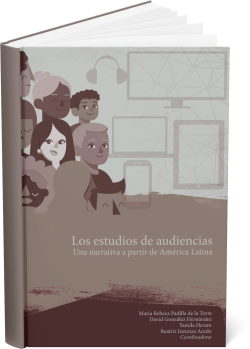
This book takes on the challenging task of documenting and analyzing the profound and diverse changes that have steadily transformed audiences in the wake of the rise of digital technologies. These processes of change have made them so complex to address that their relevance as a subject of study has been called into question.
This work contributes to this discussion from a Latin American perspective, with a particular focus on compiling and examining the ways in which this field of study has been framed, debated, and reformulated within the context of a complex shift in communication—from mass media to digital environments—characterized by its hybrid, diverse, and deeply unequal nature. In particular, the book offers valuable insights for constructing a future research agenda on audiences based on a plurality of theoretical and methodological approaches presented by authors from different generations, academic backgrounds, and geographical origins, which significantly enriches its proposal.
This project has led to the formation of the Latin American Network for Audience and Reception Studies (RELATA), a network open to researchers in Latin America that aims to leverage their professional backgrounds, experiences, and resources in order to broaden the scope of individual academic work. Thus, the papers accepted through the call for submissions for the book, which was open from December 2023 to February 2024, have been organized into four major themes that constitute the sections of this book: theoretical and conceptual updates on audiences; history, trends, and methodologies in audience studies; perspectives for the study of audiences; and audience profiles.
This publication, the result of a collective effort, not only contributes to reception studies but also highlights the distinctive characteristics of Latin American audiences. Globally, there is a need to bring greater visibility to the research conducted in our contexts and to emphasize what is sui generis to our culture(s).
Each chapter, on its own, offers insights and findings of considerable interest; however, it is in its cross-cutting dimension that the work acquires a particular richness by providing a fairly comprehensive overview of the critical reflections, schools of thought, and research that have approached audiences as a complex and challenging subject of study. Taken as a whole, this book provides a valuable update and guide for understanding, from a variety of theoretical and methodological perspectives, the great diversity among audiences, as well as the multiple modalities that shape their practices.
Chapters
-
Introduction
-
PART 1Theoretical and conceptual updates on the audiences
-
The audience as an object of study.Problematization and updating
-
The social audience.Participation, interaction and production of audiences in the digital environment
-
Audiences, audiences, users: practices and affects around media in the digital environment
-
Social bots as part of digital audiences
-
PART 2History, trends and methodologies in audience studies
-
Metaphors of reception.Stories, ideas, authors
-
From private interest to governmental questioning: the concepts of "audiences" and "publics" in audiovisual studies
-
Audience studies: between conceptual heterogeneity, theoretical hybridity and lack of specificity
-
Studies on audiences in digital scenarios in Latin America.Literature review
-
Measuring audiovisual consumption: new problems linked to the deepening of the mediatization process
-
Notes for studying time and space in the consumption of long-running serialized fiction
-
PART 3.Perspectives for the study of audiences
-
Audience studies from the perspective of education and communication in Latin America
-
Debates on the right of audiences to audiovisual services on the Internet in Latin America
-
Reception studies on VOD audiences in Latin America
-
Mediations and religiosities: a proposal to study audiences and their religious practices from the Barberian perspective of nocturnal maps
-
Press-audience relationship in Latin America: insights into a multifaceted phenomenon
-
The local dimension in audience studies.A state of the art on news circuits in the digital era
-
PART 4.Audience profiles
-
Latin American young audiences: analysis of scientific articles from 2019 to 2023
-
Literature review on children's audiences in Latin America: trajectories and perspectives (2014-2024)
-
Fanatical audiences.Reflections on the Latin American approaches to contemporary modalities of reception
-
Towards media justice: reflections on Latin American LGBTIQA+ audiences in the context of digital convergence
-
Validation by users in the production of media accessibility: contributions to thinking from reception studies
-
Beyond the urban-rural dichotomy: investigating Latin American audiences from the perspective of rurbanity
-
Migrations and digital technologies in the perspective of Latin American reception studies
Downloads
Published
Series
Categories
License

This work is licensed under a Creative Commons Attribution-ShareAlike 4.0 International License.